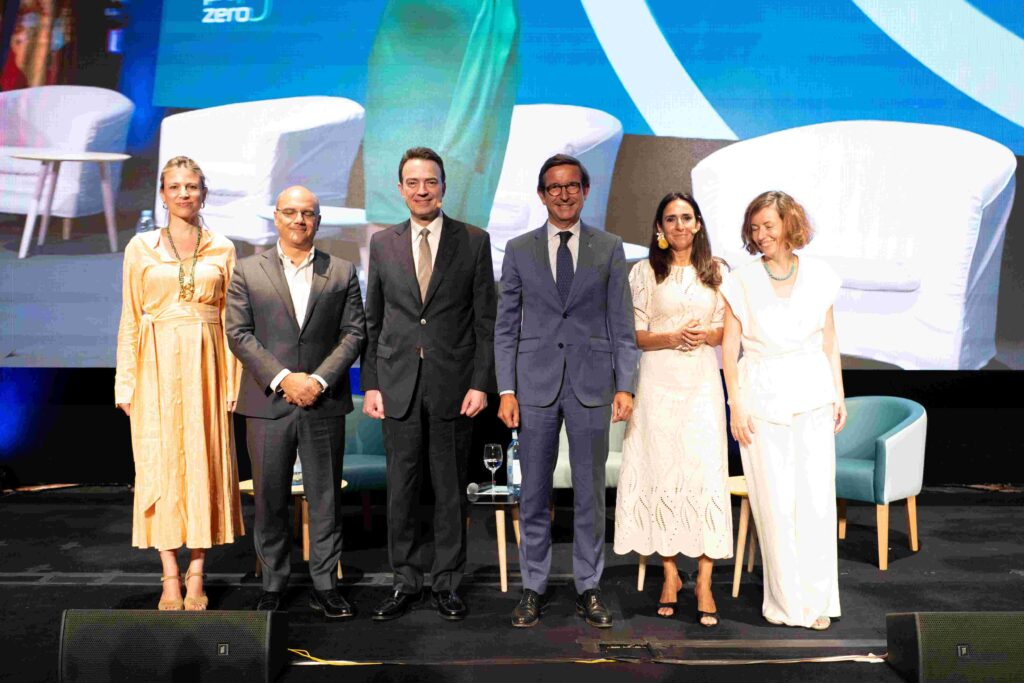
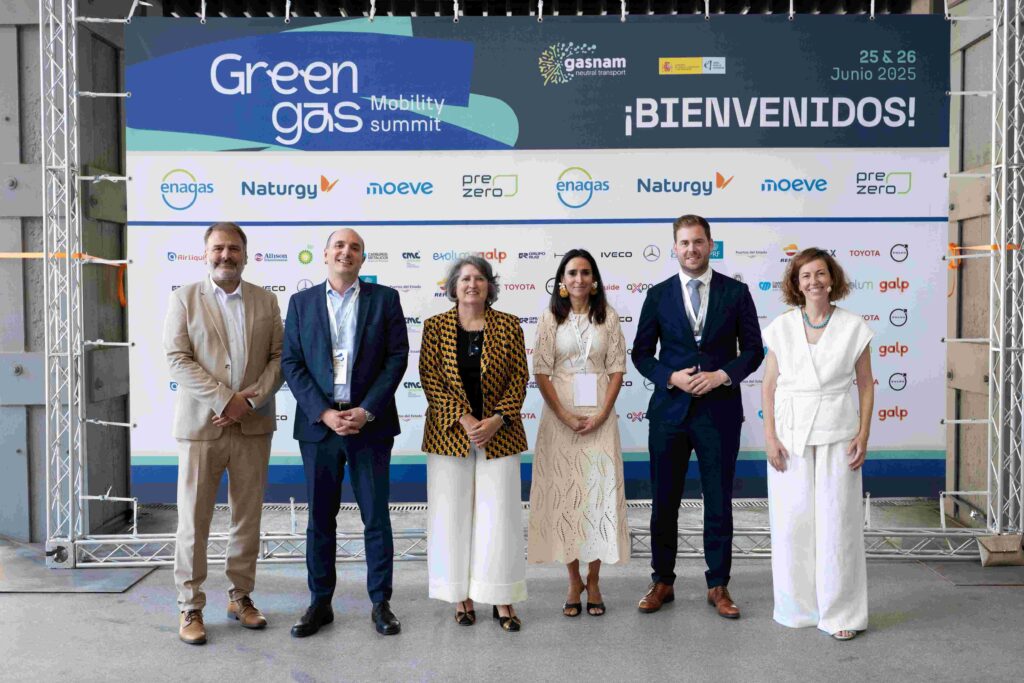
- Green Gas Mobility Summit, organised by Gasnam, has shown that Spain has the necessary resources to lead a competitive production of renewable gases, essential to decarbonise land, sea and air transport.
- The historic opportunity that renewable gases represent requires streamlined administrative procedures for project development and a clear and stable regulatory environment to drive investment.
With a record participation of companies, institutions and experts from the energy sector and transport by land, sea and air, a new edition of the Green Gas Mobility Summit was held, the forum organised by Gasnam that has become a benchmark in sustainable mobility in the Iberian Peninsula.
During the inaugural speech, the president of Gasnam, Silvia Sanjoaquín, highlighted the strategic role that transport plays for the future of the country. ‘If we know how to take advantage of the combination of capabilities offered by the Iberian Peninsula (renewable resources, geographical position, industrial fabric and logistical experience), we can become a European reference in sustainable transport by land, sea and air’, she said.
A position that has also been supported by the Minister of Sustainable Development of the Government of Castilla-La Mancha, Mercedes Gómez, and by the Director General of Industry, Energy and Mines of the Region of Murcia, Federico Miralles, who have ratified their commitment to an energy model linked to the territory, generating employment and competitive, based on biomethane and hydrogen. In this regard, Mercedes Gómez stressed that Castilla-La Mancha is accelerating its energy transition with a pioneering regulation that promotes the deployment of these renewable gases as a key tool to advance regional decarbonisation, while Federico Miralles highlighted the potential of the Region of Murcia as a pole of attraction for energy investment and its firm commitment to biomethane, green hydrogen and the decarbonisation of transport as drivers of employment and competitiveness.
The institutional vision was joined by voices from the business sector, who agreed on the need for a clear and stable regulatory framework. While Naturgy’s General Manager of Renewable Gases, José Luis Gil, defended biomethane as an efficient solution for decarbonising sectors that are difficult to electrify, ‘as long as there is a predictable regulation that supports investments’, the CEO of PreZero Iberia, Gonzalo Cañete, stressed that Spain needs to optimise its energy mix and that, to achieve this, biomethane will be an essential element in the coming years.
Hydrogen was the protagonist of the second part of the day, with the Andalusian Green Hydrogen Valley as an outstanding example of Spain’s commitment to this energy vector. Moeve’s Vice President of Commercial & Clean Energies, Carlos Barrasa, presented this project (the most ambitious in Europe for the production of this renewable gas), and stated that the company will begin construction this year and that it will have 400 MW of electrolysis to supply industry and transport.
In a dialogue with the Minister of Industry, Energy and Mines of the Regional Government of Andalusia, Jorge Paradela, who stated that Andalusia could be the major producer of clean energy in the south of the European Union, especially green hydrogen, the CEO of Enagás, Arturo Gonzalo, pointed out that ‘Spain is called to play a leading role in the new energy map of Europe as a major green hydrogen power’, highlighting the key role of infrastructure to make this possible”. He also stressed that ‘in heavy transport, the competitiveness gap between hydrogen and traditional fuels is narrowing rapidly’.
In line with this vision of the country, the deputy national secretary for Sustainable Development of the Partido Popular, Paloma Martín, stressed that making Spain a more sustainable and competitive country must be a political priority.
Maritime transport: key players in the transformation
The Secretary General for Air and Maritime Transport of the MITMA, Benito Núñez, has presented the Spanish Maritime Strategy 2025-2050, an instrument that is emerging as the backbone for the decarbonisation and modernisation of the maritime sector in our country. In line with this strategy, various key players in the sector – such as shipping companies (CMA CGM), engine manufacturers (Wärtsilä), classification societies (Bureau Veritas and DNV), engineering companies (Cotenaval) and suppliers of new fuels (Axpo, Moeve and Repsol) – together with Puertos del Estado, have demonstrated their commitment through significant investments in alternative fuels and a strong spirit of collaboration with all the representatives of the maritime logistics chain.
Aviation: the need to scale solutions
The maritime sector has highlighted the momentum in the construction of new LNG-powered ships, as well as Spain’s leadership in their supply, with more than 2,000 operations carried out by 2024. In addition, the start of the first operations with bio-LNG has been highlighted, confirming the immediate viability of this renewable alternative.
Biomethane and hydrogen on the road: from promise to reality
On the road, manufacturers, logistics operators and passenger transport companies (Volvo Trucks, CESPIRA, Iveco, Transportes F. Méndez, TUSSAM and Grupo Ruiz), defended the role of biomethane for the immediate decarbonisation of heavy transport, a fuel which, as confirmed by Molgas Group, is already available in our country. For her part, the Director General of Road and Rail Transport of the MITMA, Elena Atance, stressed the importance of public-private collaboration in tackling this major challenge.
Hydrogen mobility is no longer a project of the future but a tangible reality. This has been demonstrated by TMB with almost 50 fuel cell buses circulating in the city of Barcelona or the joint project of Carreras Grupo Logístico, Repsol and Zoilo Ríos SA.
A strategic opportunity for Spain and a call to action
Companies, institutions and representatives of the transport and energy sectors have agreed on a clear message: Spain has a historic opportunity to lead clean, efficient and competitive mobility by land, sea and air. However, this leadership will only be possible if administrative procedures are streamlined and European directives are transposed, allowing many projects to make the definitive leap.
The Green Gas Mobility Summit has thus reaffirmed its role as a benchmark space for public-private collaboration and as a lever for accelerating the transformation of transport through technologically neutral and sustainable solutions.