- The Iberian Peninsula can lead Europe in the production of the renewable and synthetic gaseous fuels that the transport sector needs to meet its climate targets.
- Harnessing the potential of renewable gases requires a stable regulatory framework to incentivise investment and stimulate demand.
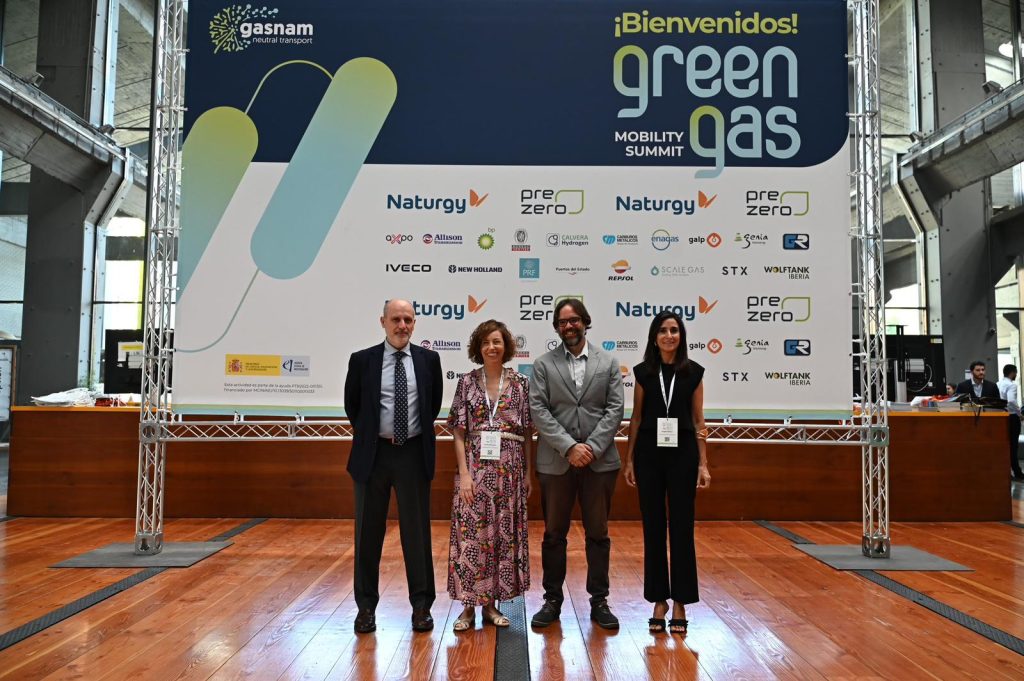
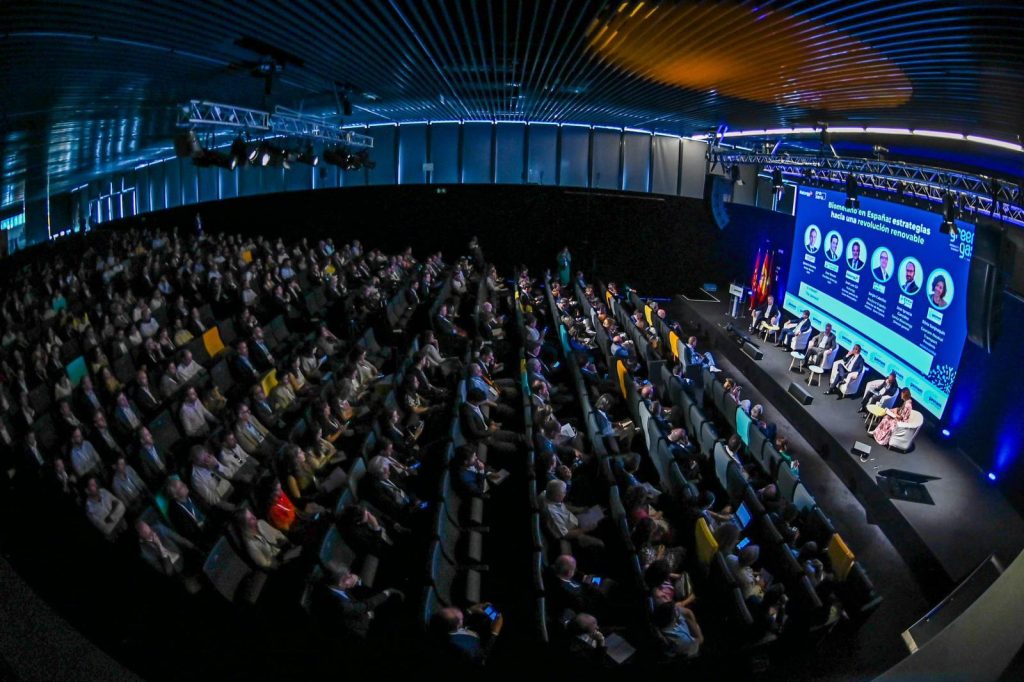
Green Gas Mobility Summit, the meeting that brings together the entire value chain of renewable gases, met in Madrid on 3 and 4 July. Representatives of the agricultural and livestock sector, promoters of renewable gas production projects, vehicle and engine manufacturers, logistics operators and institutions have analysed for two days the levers that will allow us to lead the production of renewable gases in the Iberian Peninsula and the value that this renewable energy offers to the transport sector to achieve its climate objectives.
‘We are driven by a common goal,’ said Silvia Sanjoaquin, president of Gasnam-Neutral Transport, ’to make affordable renewable gases available to our society, helping to decarbonise all sectors of our economy, including transport, while at the same time boosting the circular economy and strengthening our energy independence. The President also stressed that, although there is still some way to go, it is necessary to make progress on a stable regulatory framework that encourages investment, reduces the competitiveness gap and facilitates the creation of an efficient market for renewable gases. It should be remembered that Spain, despite being one of the European countries with the greatest potential for biomethane production, only has ten plants in operation compared to more than 500 in countries such as France.
Along the same lines, the Director of Public Business – Central Zone of PreZero Spain, Sergio Cabellos, stated that ‘climate and decarbonisation policies are unstoppable. As a country, we must take advantage of the opportunity we have to move up in the ranking of European countries in biomethane production’. To which Naturgy’s General Manager of Renewable Gases, José Luis Gil, pointed out that ‘we must achieve the decarbonisation objectives in a cost-efficient way for families and industries. Biomethane is already a mature technology and production is continuous. It is one of the few 24/7 renewable sources and it is also easily stored at low cost’.
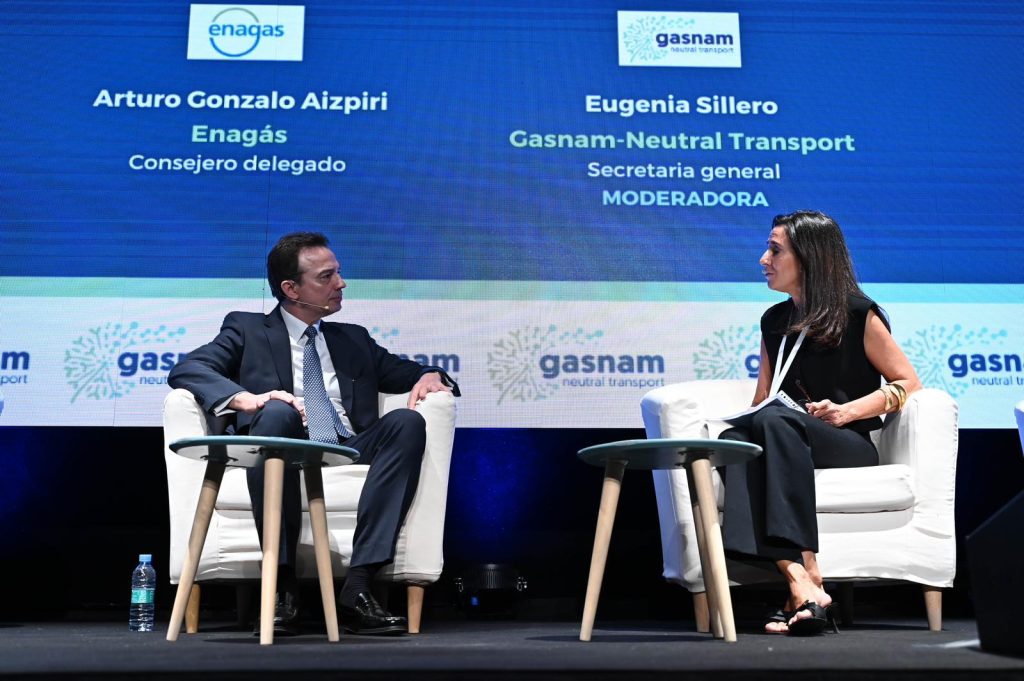
The CEO of Enagás, Arturo Gonzalo Aizpiri, in a conversation with the Secretary General of Gasnam-Neutral Transport, Eugenia Sillero, stated that ‘green hydrogen is going to be a clear protagonist in mobility, as an ideal complement to the electrification of the automobile and allowing the decarbonisation of heavy road transport, in addition to the fundamental role it will play in maritime and air transport’. To this end, he stressed that ‘it is necessary to develop infrastructures for the production, transport and storage of hydrogen, as well as the deployment of hydrogen plants in the coming years’, and recalled that ‘it is precisely the infrastructures that have enabled Spain to lead the decarbonisation of maritime transport with LNG today’.
Road transport was represented by vehicle manufacturers and logistics operators. Iveco, Volvo and Scania presented the renewed range of long-haul truck engines prepared to use BioGNL, which makes them immediately emission-neutral. Zero-emission hydrogen developments have also been presented, both fuel cell and hydrogen combustion engines.
As a novelty, at the exhibition accompanying the event we had the opportunity to see, for the first time in Spain, the IVECO Bus E-Way, an innovative city bus with fast hydrogen charging, high capacity and high efficiency.
Vehicle manufacturers, road transport operators and shipping companies have stressed that the challenge of decarbonising transport is so great that it requires the contribution of all clean energies and a technology-neutral approach from the Administration, from which they demand budgetary instruments to help reduce the competitiveness gap that exists today.
Maritime transport also played a leading role in this event. Natural gas continues to be the alternative fuel that leads the decarbonisation of this sector, and proof of this is that in Spanish ports the supply of LNG to ships for their propulsion has quadrupled in the last two years.
The event was also attended by banks (Banco Sabadell, BBVA, ING España and Santander), political parties (PP, PSOE, Vox, and SUMAR) and a large institutional representation from the Ministry of Transport and Sustainable Mobility (Álvaro Fernández, Secretary General for Sustainable Mobility; and Benito Núñez, Secretary General for Air and Maritime Transport), from the government of the Community of Madrid (Jorge Rodrigo, Regional Minister for Housing, Transport and Infrastructures) and from Madrid City Council (Ángel Niño, Councillor for Innovation and Entrepreneurship).
The congress has proven to be a key platform for the exchange of knowledge and the promotion of innovative solutions in the field of sustainable mobility, once again positioning itself as a benchmark in the Iberian Peninsula. More than 1,100 people accredited in this edition, together with a wide institutional representation and the presence of leading energy and transport companies, and a large indoor and outdoor exhibition with biomethane and hydrogen vehicles, have consolidated Green Gas Mobility Summit as a key event to promote the decarbonisation of transport.